Do You Hear Them Sing?
The Music As the Protest





Music is a universal language, that is able to tell stories and unify, and above all, and to communicate a host of feelings and emotions. One way that music does this is by lending itself to the mood of the day.
Whether gospel music, club hits, or even the national anthem, in times of social unrest, music can be a mirror for reflection, a door for escapism, or a platform to speak truth to power - a way for the oppressed to communicate their own oppression.
Through music, we can communicate and connect with the national zeitgeist in a way that is both memorable and momentous, and the songs that we pick and choose to add to our own playlists, effectively becomes the soundtracks of our lives.
Since independence, Kenyan musicians have lent their voices to popular discourse, whether its Ramogi and Kamaru helping us grieve the assassinations of the 60s and 70s, Omolo and Rateng' capturing a life getting harder by the day in the 70s and 80s, or Kalamashaka and Ukoo Flani infusing Kenyan hip hop with their frustration and anger at the turn of the century.
Now, a new generation is insisting that we must Anguka Nayo!
Protest music is much more than the lyrics and artists behind them. It is the story of a people harassed, gagged, bamboozled, oppressed, beaten and killed. It is both an acknowledgement and a rejection of the status quo. It is the fierce manifestation of a spirit that refuses to be tamed, and as it spreads, it lights a fire, helps a nation heal, and defines who we are.
Click on the buttons below to explore songs of protest from the various eras of government in Kenya.
Interestingly, Kenya's core protest music is a form of common intellectual property. It is largely unrecorded, highly derivative, and borrowed from various sources, including gospel music, traditional music, sports chants, and pop music.
The protest song ‘Bado Mapambano’ (the struggle continues) for example is derived from a gospel song, ‘Wakristu msilale bado mapambano’ that originally implored Christians that the fight against Satan was not over yet. The late Homa Bay Senator Otieno Kajwang found it fitting to borrow the tune and aim it at the fight against government. Over the years, versions of other popular gospel songs like Yote Yawezekana, Kuna Dawa, Iende Mbele Injili Ooh too have been adopted into protest music.
@its_manuel.mandela Its going down#comrades #helb #comradespower #trending #viral #viralvideo #kenyantiktok #university #TUK #UON#JKUAT #KU #fyppppppppppppppppppppppp ♬ original sound - manuelmandela
Sounds and phrases can be borrowed from far and wide. The term ‘Comrade’ was popularized by 1990s University of Nairobi student leaders, influenced by Marxist ideas from the Soviet Union, where Communist Party members used it (e.g., Comrade Lenin, Comrade Stalin). And so the term from one struggle was co-opted into another, half a world away, and has stuck to this day.
@its.mumush.ka this got me 😂😂🫴#maandamano #fyppppppppppppppppppppppp #fypage #mturaisafruit #rejectfinancebill2024✊🇰🇪 #politics#punda #agwambo #trending #trend #rejectfinancebill2024🇰🇪 #genzie #trendingvideo #viralvideo #maandamanobilateargas🤣🤣🤣 #revolution #petition #blowthisup #maandamanobilateargas🤣🤣🤣 #viralvideo #trendingvideo #financebill2024 #protest ♬ original sound - its.mumush.ka
Sometimes, these songs emerge spontaneously, a collective creation born from the anger, pain, and struggle of the moment, and are sustained through oral tradition. The 2024 protests have introduced some new sounds that are making a quiet bid to be included in this public canon. Only time will reveal how they will be remembered.
It’s arguably the greatest stroke of luck an artist can hope for: releasing a song during a politically charged time, only for it to become the perfect soundtrack for the moment. We call this phenomenon the Unbwogable Syndrome, named after Gidi Gidi Maji Maji's hit song that resonated through Kenya’s 2002 elections.
@gidiogidi #REJECT #unbwogable ♬ original sound - Gidi Ogidi
The song was a quick composition born out of anger and frustration with a broken system, and literally mixed in half an hour. But in a weird twist of fate, the little loved tune became one of duo’s biggest hits ever, rising to the top of charts instantly, sealing them a record deal and ironically attracting the attention (and money) of politicians looking to buy it for their campaigns.
Fast forward to 2024, and another youth duo called Wadagliz, release Anguka Nayo amidst Kenya’s Finance Bill 2024 protests. In their own words, the song was meant to be a good old party song, but was rapidly adopted as the protest’s unofficial anthem, garnering over 1 million views within a week of release. Its title, loosely translated to fall/out with it, was just the perfect chant for a protest that led to the ‘falling’.of the Finance Bill 2024.
@petermuks #financebillkenya2024 #financebillkenya #rejectfinancebill2024✊🇰🇪 #kenyantiktok🇰🇪 #rejectfinancebill2024🇰🇪 #afterpartyprotests @Fred Warren @Khatali Kenya @Abigael_lavender @Millennial Bestie 🌹 ♬ original sound - Peter Muks
A casual analysis of other Kenyan songs that have benefited from this phenomenon reveals why they are so easily co-opted into protest. Tracks like Nobody Can Stop Reggae, Sipangwingwi (I Cannot Be Controlled), and Gotha Tena (Hit Me Again) cover a wide range of topics, but the defiant title and hook transformed them into protest anthems.
As seen in the post-protest street parties and clubs during the 2024 maandamanos, the inherent magic of these songs is how they allow Kenyans the duality of enjoying the escapism of a party while staying true to the protest spirit.
National Anthem as a Protest Song
Few experiences capture the essence of civic protest as powerfully as being brutalized by police while singing the national anthem. In this stark physical conflict lies a deeper, metaphorical struggle for the soul and identity of a nation.
Our national anthem has turned out to be the greatest protest song our land has. Bless those writers of this hit song
— Njagĩ (@_Njagi_) July 13, 2024
The national anthem possesses a rare versatility, serving as an effective soundtrack across various contexts—whether during national celebrations, school assemblies, or tear-gas-filled street protests. It seamlessly adapts to the occasion, embodying a profound sense of unity and purpose.
The national anthem uniting young Kenyans in this crucial moment in history 🇰🇪#occupyBungeKE #OccupyParliament#RejectFinanceBill2024 pic.twitter.com/4quUhL4TCi
— Tom Mukhwana (@tom_mukhwana) June 20, 2024
As a revered composition, the national anthem embodies national pride, freedom, and patriotism in a way that few other symbols can match, with the flag being its closest counterpart. When citizens perceive these values to be under threat, they cling to these symbols, seeking to reclaim and reinvigorate them with the dignity they feel has been lost. In this way, protest becomes an act of patriotism, and the national anthem emerges as the ultimate protest song.
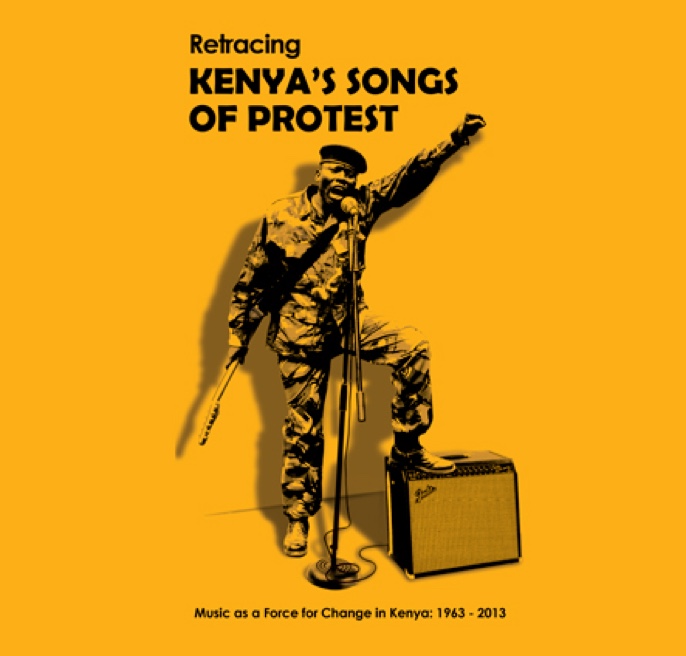
We’d like to recognize Ketebul Music’s pioneering work on this subject. Led by Tabu Osusa, they wrote the first chapter of this story when they compiled and released the timeless 'Retracing Kenya's Songs of Protest' book (with audio CD and documentary DVD). It is on their shoulders that we stand and are honored to add a new chapter to this incredibly vital work. You can purchase a copy of the book at the link below.
BUY THE BOOK